
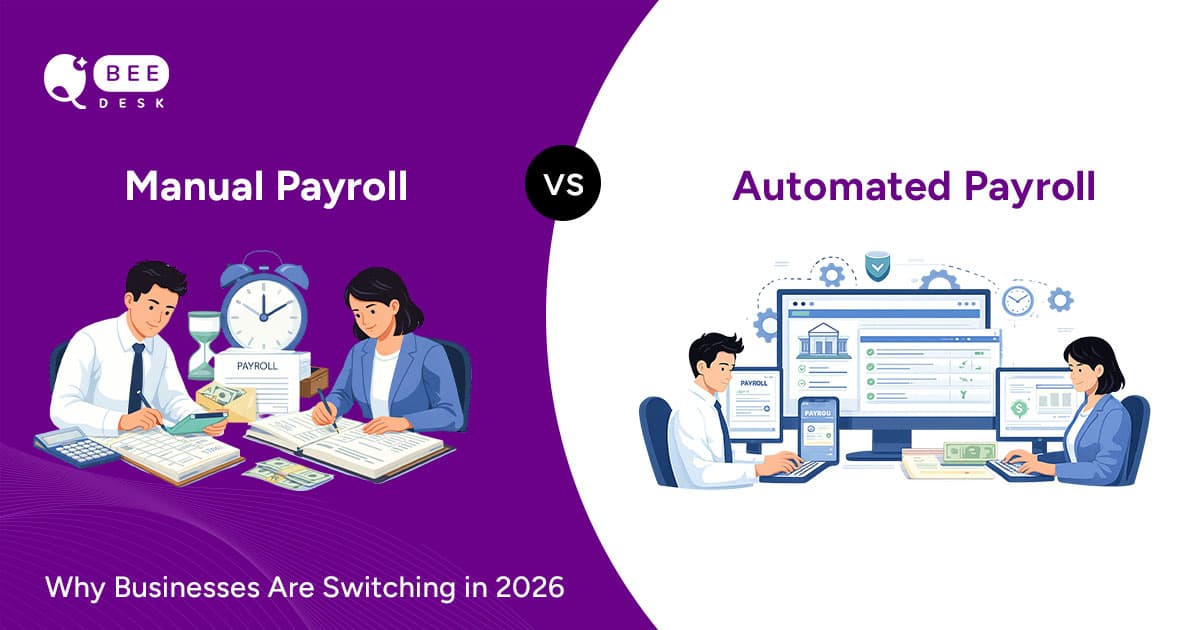
Manual Payroll vs Automated Payroll: Why Businesses Are Switching in 2026

Payroll has always been a critical function in any organisation, but in 2026, the expectations around payroll have evolved significantly. It is no longer just about calculating salaries and transferring payments. Today, payroll is deeply connected to employee experience, compliance, operational efficiency, and business scalability.
Despite this shift, many businesses still rely on manual payroll systems—primarily spreadsheets, fragmented tools, and human calculations. While this approach might seem manageable in the early stages, it becomes increasingly inefficient as the organisation grows.
This is why businesses across industries are rapidly moving toward automated payroll systems like QbeeDesk. The transition is not just a technological upgrade—it is a strategic shift toward accuracy, scalability, and smarter operations.
The Reality of Manual Payroll in Modern Businesses
Manual payroll systems are built on a combination of spreadsheets, emails, and disconnected tools. At first glance, this setup may appear cost-effective and flexible. However, as employee count increases and compensation structures become more complex, the cracks begin to show.
The biggest challenge with manual payroll is inconsistency. Every month, HR teams are required to calculate salaries from scratch—factoring in attendance, leaves, overtime, bonuses, deductions, and statutory components. Even a small oversight in any of these elements can lead to incorrect payouts.
Another major issue is the lack of structure. Without predefined salary components, businesses often handle payroll as a single figure rather than a breakdown of earnings and deductions. This not only creates confusion but also makes compliance and reporting more difficult.
Manual systems also struggle with tracking dynamic elements like employee loans, bonuses, and adjustments. These are often maintained in separate sheets, increasing the risk of duplication, missed entries, or incorrect calculations.
Over time, what starts as a simple process becomes a time-consuming and error-prone operation that affects both HR efficiency and employee trust.
What Automated Payroll Changes Completely
Automated payroll systems fundamentally change how payroll is managed. Instead of recalculating everything every month, businesses define the structure once and allow the system to handle calculations automatically.
QbeeDesk is designed around this principle. It introduces a modular approach to payroll, where every element—salary components, structures, deductions, bonuses, and payouts—is clearly defined and interconnected.
This structured approach eliminates ambiguity. Once components like Basic Pay, HRA, DA, or overtime are configured, they become reusable building blocks. Payroll is no longer dependent on manual inputs but driven by predefined logic.
Automation also ensures consistency. Every employee’s salary is calculated based on the same rules, reducing discrepancies and ensuring fairness. This is particularly important for growing teams, where maintaining uniformity can become a significant challenge.
More importantly, automation shifts payroll from a reactive process to a proactive system. Instead of fixing errors after they occur, businesses can prevent them entirely.
Accuracy: The Biggest Advantage of Automation
Accuracy is the backbone of any payroll system. In manual processes, accuracy depends entirely on human effort, which makes it vulnerable to errors.
Automated systems like QbeeDesk remove this dependency by handling calculations programmatically. Whether it is a fixed salary component, a percentage-based allowance, or a pro-rata adjustment, every calculation follows predefined rules.
For example, if an employee has fewer working days in a month, QbeeDesk automatically adjusts their salary using pro-rata logic. Similarly, overtime is calculated based on predefined conditions, ensuring that employees are compensated fairly for extra work.
Deductions such as taxes, short-time penalties, or loan repayments are also applied consistently. Since all components are interconnected, there is no risk of missing or duplicating entries.
This level of accuracy not only reduces payroll errors but also builds trust among employees, who can rely on the system to deliver correct payouts every time.
Efficiency: From Hours of Work to Minutes
One of the most immediate benefits of automation is the time it saves. Manual payroll processing can take hours or even days, especially when dealing with multiple employees and complex salary structures.
With QbeeDesk, the entire process is streamlined. Once salary components and structures are defined, payroll runs become significantly faster. HR teams no longer need to calculate each salary manually or cross-check multiple data sources.
Payslip generation, which is often a separate and time-consuming task in manual systems, is fully integrated. The system automatically generates payslips with detailed breakdowns of earnings, deductions, and net pay.
This efficiency allows HR teams to focus on more strategic activities, such as employee engagement and organisational planning, rather than getting stuck in repetitive administrative tasks.
Flexibility: Adapting to Real-World Business Needs
Modern businesses require payroll flexibility, as no two organisations have identical compensation structures. Manual systems often struggle to accommodate this complexity without becoming chaotic.
QbeeDesk addresses this by offering flexible configuration options. Salary components can be defined as fixed amounts or percentages, depending on the requirement. Billing units can be set to monthly, hourly, or even minute-based calculations, making it suitable for diverse workforce models.
This flexibility extends to bonuses and incentives as well. Businesses can define bonuses as fixed payouts or link them to specific salary components, ensuring that incentive structures align with organisational goals.
Loan and advance management is another area where flexibility is crucial. QbeeDesk allows businesses to define repayment schedules and automatically deduct amounts during payroll cycles, ensuring seamless financial adjustments.
By providing a system that adapts to business needs rather than forcing rigid structures, QbeeDesk enables organisations to scale without operational friction.
Transparency: Building Trust Through Clarity
Transparency is often overlooked in payroll systems, yet it plays a crucial role in employee satisfaction. When employees do not understand how their salary is calculated, it leads to confusion and mistrust.
QbeeDesk solves this by providing clear and detailed payslips that break down every component of the salary. Employees can see exactly how their earnings and deductions are calculated, making the process fully transparent.
For HR teams, this transparency reduces the number of payroll-related queries and disputes. Since every calculation is visible and traceable, there is little room for ambiguity.
This clarity also extends to internal processes. With a centralised system, businesses have complete visibility into payroll data, making it easier to track expenses, analyse trends, and make informed decisions.
Attendance Integration: The Missing Link in Manual Payroll
One of the biggest limitations of manual payroll is the disconnect between attendance and salary calculations. HR teams often have to manually adjust salaries based on attendance records, which increases the risk of errors.
QbeeDesk integrates attendance directly into payroll, ensuring that calculations reflect actual working conditions. Working days, overtime, and short-time deductions are automatically factored into salary calculations.
This integration eliminates the need for manual adjustments and ensures that payroll is always aligned with attendance data. It is particularly beneficial for organisations with shift-based or hourly employees, where manual calculations can become extremely complex.
By bridging this gap, QbeeDesk ensures that payroll is not only accurate but also fair and consistent.
Workflow Control: From Draft to Payment
Payroll is not just about calculations—it is also about process control. Manual systems often lack a structured workflow, making it difficult to review and approve payroll before finalising it.
QbeeDesk introduces a clear workflow where payslips move through different stages, such as draft, approved, and paid. This ensures that every payroll cycle is reviewed and validated before payments are processed.
HR teams can make adjustments during the draft stage, verify calculations during approval, and finalise payouts with confidence. This structured approach reduces errors and ensures accountability at every step.
Why QbeeDesk Stands Out in the Market
While there are many payroll solutions available, QbeeDesk stands out because of its balance between simplicity and capability. It is not just a payroll tool—it is a complete payroll ecosystem designed for modern businesses.
Unlike traditional systems that focus only on calculations, QbeeDesk integrates every aspect of payroll into a single platform. From salary components and structures to loans, bonuses, and payslips, everything is interconnected and automated.
The user interface is intuitive, making it easy for HR teams to configure and manage payroll without extensive training. At the same time, the system is powerful enough to handle complex scenarios, ensuring that businesses do not outgrow the platform as they scale.
Most importantly, QbeeDesk is built with real business challenges in mind. It addresses the pain points of manual payroll while providing the flexibility and control needed for modern operations.
The Shift to Automation is No Longer Optional
In 2026, the shift from manual to automated payroll is no longer a trend—it is a necessity. Businesses that continue to rely on manual systems risk falling behind in terms of efficiency, accuracy, and employee satisfaction.
Automation is not just about saving time; it is about creating a reliable and scalable system that supports business growth. It ensures that payroll is always accurate, compliant, and aligned with organisational needs.
QbeeDesk enables this transformation by providing a comprehensive payroll solution that simplifies complexity and delivers consistent results.
Final Thoughts
Manual payroll may have worked in the past, but it is no longer suitable for modern businesses. The increasing complexity of compensation structures, compliance requirements, and workforce dynamics demands a smarter approach.
Automated payroll systems like QbeeDesk offer that solution. By combining structured components, real-time calculations, attendance integration, and workflow management, QbeeDesk transforms payroll into a seamless and efficient process.
For businesses looking to improve accuracy, save time, and build trust with employees, the choice is clear.
The future of payroll is automated—and QbeeDesk is leading the way.